Olive oil production is one of the oldest food-processing traditions in the Mediterranean. For centuries, olives have been harvested, crushed and pressed to extract one of the region’s most valuable agricultural products.
Today, however, the production environment looks very different.
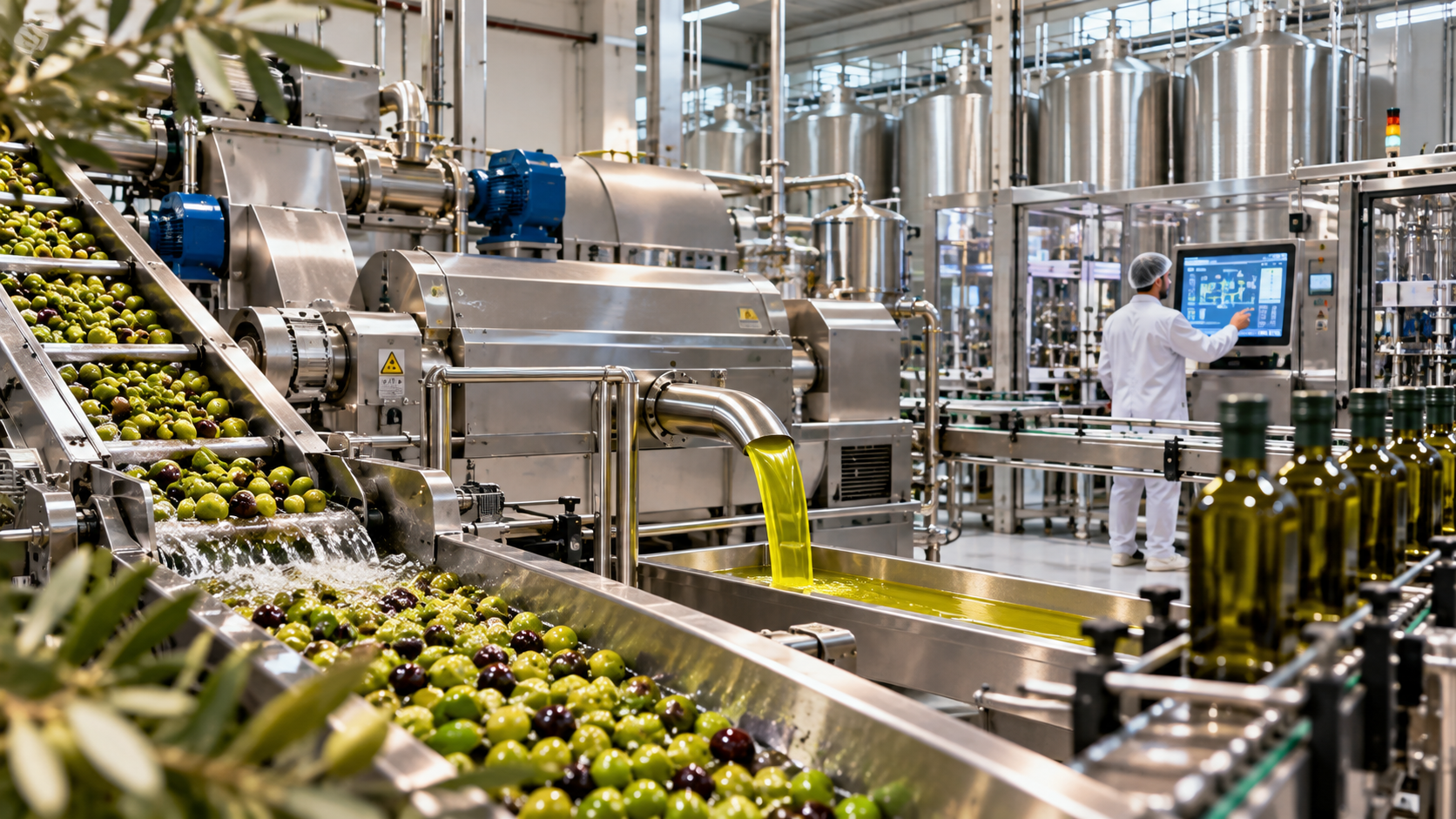
Modern olive oil facilities increasingly combine traditional knowledge with automated processing systems, stainless-steel equipment and controlled production methods. From the moment olives arrive at the facility until the oil is transferred to storage tanks, technology plays an important role in maintaining efficient, hygienic and consistent production.
For international B2B buyers, understanding how olive oil is produced can also provide useful insight into product quality, processing methods and supplier capabilities.
The olive oil production process begins long before the olives enter the processing line.
After harvesting, olives are transported to the production facility where they are prepared for processing. The time between harvesting and processing can be an important consideration because the condition of the fruit may influence the characteristics of the final olive oil.
Once received at the facility, olives generally pass through an initial preparation stage where leaves, branches and other foreign materials are removed.
The olives are then washed before entering the main production process.
Modern production lines allow many of these operations to take place continuously, reducing unnecessary handling while creating a more controlled production environment.
After cleaning, the olives move to the crushing stage.
Unlike traditional methods that relied heavily on stone mills and mechanical presses, modern facilities commonly use industrial crushing systems designed for continuous processing.
The purpose remains fundamentally the same: breaking down the olives so that the oil contained within the fruit can eventually be separated.
Modern equipment allows producers to manage this stage more efficiently while maintaining greater control over the production process.
After crushing, the resulting olive paste enters a process known as malaxation.
During this stage, the olive paste is slowly mixed under controlled conditions. This allows small droplets of oil within the paste to combine into larger droplets, making the subsequent separation process more effective.
Temperature and processing time are important parameters during this stage.
Modern production equipment enables producers to monitor and manage these conditions more precisely than was possible with many traditional production methods.
This level of process control is particularly important when producers are working to achieve specific product characteristics and quality objectives.
One of the biggest technological changes in modern olive oil production is the widespread use of centrifugal separation.
Traditional olive oil production relied heavily on mechanical pressing to separate oil from olive paste.
Modern continuous production lines generally use decanters and centrifugal separators instead.
These machines use differences in density to separate the oil from the other components of the olive paste.
The process allows production to continue efficiently through a largely closed system and reduces the need for manual product handling.
For modern food-production facilities, this can provide important advantages in terms of process efficiency, hygiene and production control.
Automation is becoming increasingly visible throughout modern olive oil facilities.
Conveyor systems transport olives between different production stages, pumps transfer liquids through closed pipelines and digital control systems allow operators to monitor important production parameters.
This does not mean that people are removed from the production process.
Operators, technicians and quality-control teams remain essential for supervising equipment, monitoring production conditions and ensuring that the process operates correctly.
The difference is that modern systems can significantly reduce unnecessary direct handling of the product.
For international food buyers, this combination of automation, controlled processing and professional supervision is becoming an increasingly important part of modern food manufacturing.
Producing the oil is only part of the process.
After separation, olive oil must be stored under suitable conditions before filling, packaging or shipment.
Modern facilities commonly use stainless-steel storage tanks designed for food production. Storage conditions are managed to help protect the oil from factors that may negatively affect its characteristics.
Depending on the product and production process, additional operations such as filtration may also take place before the oil moves to the packaging stage.
Proper storage management therefore forms an important bridge between production and the final packaged product.
The final stages of modern olive oil production can also be highly automated.
Filling lines can transfer olive oil into different packaging formats, while automated systems may support operations such as filling, capping, labelling and packing.
For B2B buyers, packaging requirements can vary considerably according to the target market and customer profile.
Retail distributors, wholesalers, HoReCa suppliers and food-service companies may require different formats and quantities.
For this reason, production capability increasingly needs to be considered together with packaging flexibility and export requirements.
Modern equipment can provide greater control, efficiency and consistency, but technology alone cannot determine the quality of olive oil.
The quality and condition of the olives entering the production line remain fundamental.
Olive variety, maturity, harvesting conditions, transportation, storage before processing and production parameters can all influence the characteristics of the final product.
Modern technology should therefore be viewed as part of a broader production system rather than as a replacement for agricultural expertise.
The strongest production processes combine suitable raw materials, experienced producers, controlled processing and modern equipment.
For professional buyers, understanding the production process can help when evaluating potential olive oil suppliers.
Instead of considering only price and packaging, buyers may also want to understand how the product is processed, stored and prepared for shipment.
Questions regarding production methods, product specifications, packaging formats, order quantities and quality requirements can be discussed before purchasing programmes are finalised.
As food supply chains become increasingly professional and transparent, this type of technical understanding can support stronger relationships between producers, suppliers and international buyers.
At Oveda Group, we work with trusted production partners in Türkiye to connect international B2B customers with suitable Turkish olive oil sourcing opportunities.
Our approach is based on understanding the requirements of each customer and evaluating appropriate product specifications, packaging alternatives, quantities and export conditions.
Modern production technology is an important part of today’s olive oil industry, but successful international sourcing also requires reliable communication, suitable production partners and effective export coordination.
Through our News & Insights section, we will continue to share developments in Turkish food production, technology, international trade and supply-chain practices.
For information about Turkish olive oil products, packaging options, quantities and export quotations, contact Oveda Group.